Upper Body Balance for Bikini
This post is part of The Ultimate Bikini Prep Guide – check out the full guide for more!
Bikini. Wellness. What do you think of?
Glutes. And legs for sure.
Upper body? Meh. Not so much.
But it’s not trivial. Development priorities still exist, but more important is balance relative to the aesthetic standard of the category.
So how do we achieve that?
Upper Body in Bikini Has One Job — Support the Overall Picture
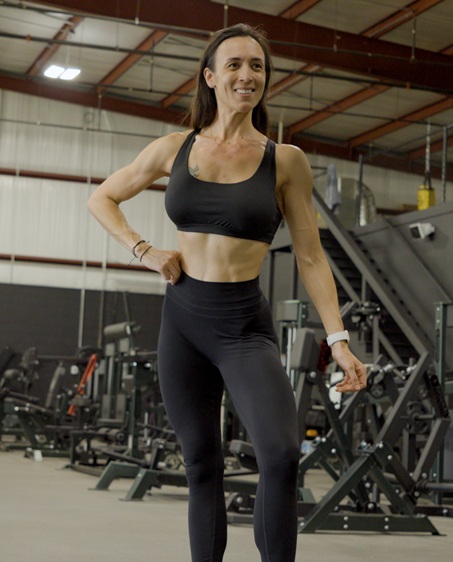
The look to avoid is one of a conventional/traditional model (no muscle) who has big legs and glutes. Both categories should feature women who clearly lift and work hard and are definitely “bodybuilders” in the broad sense of the word – but we simply don’t want your upper body stealing the show.
We’re not looking to WOW people with huge capped delts and a super thick, dense back (which often won’t be seen anyway). It’s about show, flow, and balance as defined by each category.
We don’t want to distract or pull focus, but just compliment.
This is a HARD shift for a lot of competitors to make. Often times it means significantly scaling back upper body work, or abandoning it completely if development is sufficient. I’ve had plenty of clients who do like 1 upper body day a month and that’s all they need.
You need to be able to look at yourself like a judge does – which is VERY hard to do, which is why feedback from actual judges (or your coach – who still often can be too close to really be objective) is so valuable.
The Areas That Matter Most — and Why
Let’s talk about the muscle groups that really matter by starting off with the one that doesn’t: chest. I’m pretty sure in the history of bikini and wellness, no competitor has ever been told to work on their pecs. No one cares. Breast implants (common in both categories) render this kind of moot as well, and often times training chest with high intensity after augmentation surgery becomes very problematic and can lead to future corrective procedures, so it’s best to tread lightly.
Shoulders
Shoulders are here to create the cap and accept your v-taper up from the waist. You’re not showing big capped round delts like in figure, but you want to have enough development to where you can have options when you pose. It’s easier/better to hide overdeveloped shoulders than try to to fake having ones that aren’t there.
A good mix of compounds and isolation movements are fine, the trick is to make sure that whatever you do is actually hitting the delt (don’t forget rear delts also, which can really complete the back pose) and not just overburdening the traps.
Back
Back is the one muscle group where it’s importance really depends on the organization in which you compete, and how long your hair is. If you have long hair in the NPC, your back is completely irrelevant unless you elect to show it during transitions – which, if it’s a strength, you should. Let the judges see that you’ve GOT it, then let your hair cover it in the back pose. This is a nice mental game to play – “yeah I’ve got muscle, but I’m also capable of showing you exactly what you want to see.” Three-dimensional chess right there.
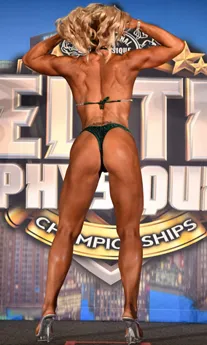
Shorter hair, or competing in other organizations like the OCB where you DO show back, returns it to a state of being important.
You want good lat development to show width and v-taper (be able to get WIDE, but your posing will not show all of that width) and also good mid-trap development to create some more dimensionality in the back pose. Wider grip rows are great for that.
Arms
Obviously no bikini or wellness athlete is hitting a double bicep pose on stage, but having some “effortless mass” where you display some size and leanness/detail without even flexing is a good asset.
Having good triceps that lean out also gives you plenty of opportunities to show them off during transitions between poses, which is where they can really stand out.
If you have a dedicated arm day, you’re overtraining them. Spend your volume elsewhere. A little – well-executed – goes a long way.
What Gets Overdeveloped — and How to Spot It on Yourself
Traps. Ok, next section.
Seriously, every female competitor wrestles with overdeveloped traps because they want to take over EVERYTHING especially with shoulders.
For many here, the situation is simple: “I overdeveloped my traps with bad form early in my lifting career and now I’m stuck with them” – this is likely true, but good posing can hide your monster traps and good form can keep them from growing further.
Lateral raises are easily the biggest culprit here. Go heavy enough and the traps are going to dominate this move.
A lot of rows – barbell, T-bar, etc – are poorly executed with too much of a shrug (vertical) component to them which brings the traps into a movement where they don’t belong.
If you’re early on in your lifting career, invest in a GOOD trainer or coach who can correct your form on these things so you don’t end up having to wrestle with this problem for the entirety of your time in bodybuilding.
Master the poses for your category and give yourself and honest assessment – are your traps dominant? Heck, are they visible? If so, they’re likely overdeveloped, and you need to recognize in the moment what movements are causing that.
Watch for neck tension, unnecessary head movement (back/forward, up/down) on back and shoulder exercises which are all evidence that the delts are asking for help from the traps.
Training Upper Body With the Right Intent
The key first steps here is to properly assess how much of a priority upper body is, based on your current physique when checking well-executed poses for your category. A needs analysis from a coach will handle this if you need 3rd party input (which I’d highly recommend).
From there it comes down to knowing how much total training volume you can effectively recover from, and how much of that needs to be dedicated above the waist. For most bikini and wellness competitors, this will be less than 50% – possibly significantly less.
I’d love to offer a specific prescription: do this stuff! But unfortunately it really needs to be handled on an individual basis. If your upper body work is mostly shoulders and back with a little arm work thrown in, that’s OFTEN a reasonable starting point.
As a coach, of course all my contest prep clients receive a needs analysis when we start with your training program built around that needs analysis.
In Bikini Blueprint, I go in depth on how to build your own needs analysis (with several examples) and then how to built a training program around that – and members of that course also have access to a private group where I’m available for questions so you can post your pics for feedback, in addition to weekly Q&A calls where we can dive deep on topics like this.
Get notified when new posts like this get published.