
What Training for Bikini Really Means
This post is part of The Ultimate Bikini Prep Guide – check out the full guide for more!
At last we’re here to talk about some fun stuff – actually lifting and doing the things that people think of when the word ‘bodybuilding’ comes up.
Training for a competitive physique is different than just going and “working out” – we’re doing things with intent and focusing on exercise selection, quality execution, form, intensity, and aligning your physique with a vision that’s in your head.
It’s more than just lifting, much more. Let’s dive in.
Training for Bikini Is About Shaping, Not Chasing Numbers
It helps to be clear on one main distinction before we get too deep.
In a growth phase, training is about building muscle. You’ll likely feel and get stronger, but SIZE is the goal, not strength. There’s correlation there but they are not the same thing.
In a cut/deficit, the goal is to retain tissue. You aren’t building anything now. If you’re maintaining performance numbers week over week, this is good.
With that framework understood, it helps create a better picture of what success looks like in the gym.
You can analyze the shit out of your logbooks (and it’s not a bad idea) but the ultimate way to check progress is visually, with standardized progress photos. Not progressing in the log book but growing in photos? Great. Change nothing.
You need to train HARD yes, but also strategically and intelligently. We want to understand the science behind what builds muscle, without thinking that that understanding can replace hard-fought intensity in your sessions.
“Science-based lifting” these days seems to want to paint a picture that if you do things smartly enough, you don’t have to kill yourself in the gym.
This isn’t true – the intensity has to be HIGH, it just has to be applied in a way that’s careful and intelligent, not reckless.
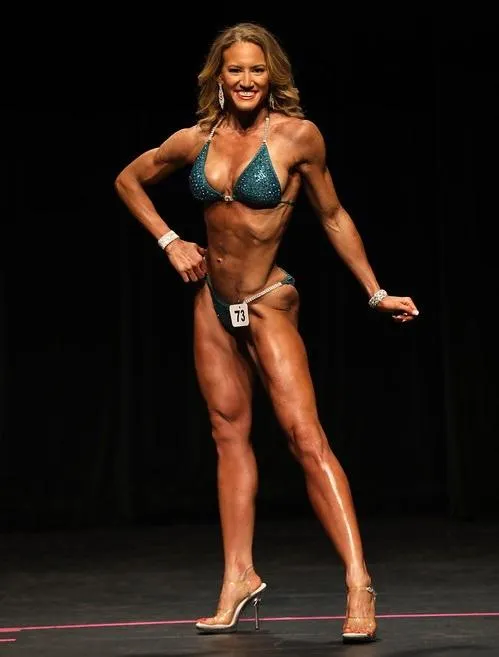
What Judges Actually Reward Should Drive Every Training Decision
If you’re a serious competitor, you should take the judge’s feedback from your last show, print it out, and tape that along with a printed out stage pic to the inside cover of your logbook. Or, since it’s 2026, maybe just screenshot both of those together and make it the lock screen of your phone. Something like that. You do you.
Point is, that needs to guide your every decision.
If the judges say you need more glutes, that’s a single piece of advice you need to spend MONTHS acting on. Don’t forget it or let it sink into the recesses of your brain. Keep it to the forefront.
Bikini doesn’t reward huge amounts of mass or extreme conditioning – that being said, there aren’t a lot of bikini competitors out there who are bringing too much muscle or too much definition to the stage. Those who are undersized and underconditioned outnumber the other group about 10 to 1.
Get bigger, get leaner – just listen to what the judges tell you also.
When in doubt, review the judging criteria for the category:
And of course this advice shifts for other categories – wellness, figure, women’s physique, etc – but the general principle and concept is the same.
Lower Body Is the Priority — And Glutes Specifically
It’s no secret that legs and glutes are the priority – moreso even in wellness.
A common criticism I hear from coaches is that “more glutes” isn’t specific enough, even though that’s what many judges say.
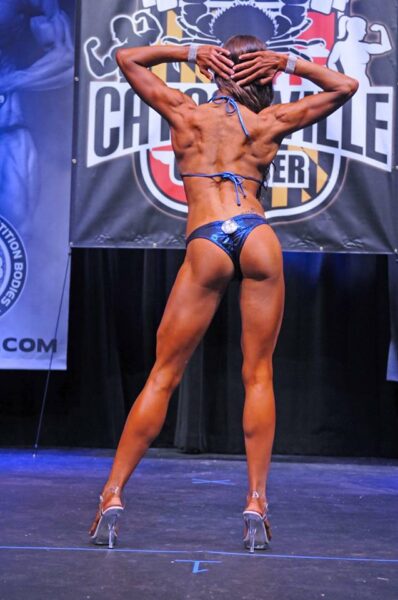
I disagree – I think it’s certainly enough of a directive but you need to use your eyes as well. Look at your pics, look at the pics of Olympia competitors. Aside from size and conditioning, how is their shape different? Are they fuller and rounder from the side? More growth laterally when view from the back? What specifically does that translate to in an anatomical sense? It’s a vague direction but it’s enough to work from.
As with everything, quality first. Focus on good, hard, borderline violent execution of your lifts. Control everything. Squeeze hard. Get full range of motion. Chase extra reps. Keep your form tight. Feel it working.
From there, you can assess your recovery and adjust volume and/or training frequency as separate variables.
Upper Body Has a Different Job in Bikini
In bikini the goal is to have an upper body that compliments your lower body and provides flow without inspiring “whoa she’s jacked!” comments. I mean, you are (or should be) but it shouldn’t look overpowering on stage.
Pulling back your frequency and intensity – if needed – is really hard for a lot of competitors. This is why many women end up changing categories, they have a hard time effectively growing their legs without the upper body coming along for the ride.
Proportion and flow. Not density, not mass.
Volume and Progression Don’t Look the Same Here
What I find almost universally is that, as a coach, when I bring on a new client who is an experienced lifter they are almost always doing too much volume.
What I like to do is simplify things – back to the basic. Four exercises per day, 2-3 hard ass working sets of each. That’s it. We pick the moves carefully and focus and making you feel like you’re dying at THAT volume level.
Flooding your CNS with volume to have a ‘hard workout’ is easy, but it’s not very effective. You can brutally execute each movement, do less, be done in less time and get better results. This is a win.
From there, we assess performance and recovery as interconnected variables and see if adjustments are needed. If you’re performing super well and recovering like a boss and setting PR’s constantly in the gym, it’s a good sign we can scale up volume a little bit – always taking that progression slowly, however.
Recovery Is Part of the Training Plan, Not Separate From It
As noted above, recovery is crucial and part of the program. I think today I’m going to implement a concept like a swear jar on my desk. Every time I tell a client to take an extra rest day, I’m going to put a quarter in the jar. In a month, I’ll update this post while on my trip around the Mediterranean that I funded with what’s in that jar.
I say it ALL THE TIME. More rest. More recovery. More time off.
But you earn that with higher intensity.
The harder you work, the more recovery time you need.
“But can I work a little less hard and take fewer rest days?” You can, but progress is much slower that way.
Keep in mind you only grow OUTSIDE the gym. You need a hard as hell training stimulus to start the growth process, but once that’s done get out.
Intent Is the Thread That Connects All of It
Ultimately it all comes back to intent. What needs to be done and why? This can be from judge’s feedback, your coach’s needs analysis, or your own breakdown. And again this applies to competitors and non-competitors alike. If you’re just looking to build a bad-ass physique for yourself, know what you want and develop a priorities list for what to grow.
Same principle as competing, but in the competitive landscape we’re always tied to what the judging standards are for our category.
Deliberate exercise selection. Focused intent. Hard sets with controlled tempo, moderate weight, and a connection to the working muscle.
Work hard, recover harder.
Get notified when new posts like this get published.